


2009.08.06


佐賀日記
Leaving Oita behind, we traveled to Saga, crossing north-central Kyushu from east to west.
While we were traveling, Hide, who usually jumps into the car and immediately starts reading a manga or starts on his laptop, spent the entire trip staring out the window. “I wish we could have stayed in Oita a little longer,” he muttered, something unusual.
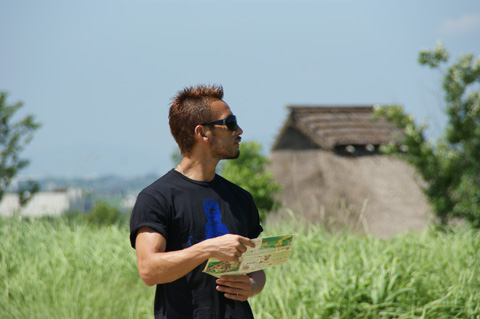
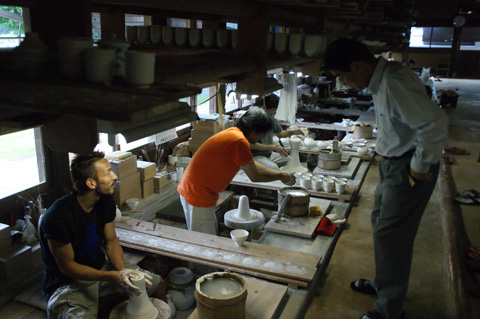
In Saga, we first headed to the Yoshinogari ruins . We visited the site, where old men, old women, and even young people are still engaged in excavation work. However, the site is so large that we had to rely on a map. That said, we staff simply followed Hide, who has an exceptionally good sense of direction. It was hot, after all. On top of that, the temperature was so high that day that we (especially Director Maki) were drenched in sweat, even though we weren’t in great physical condition. Strangely, Hide only had a slight sweat on his forehead. “The difference between a top athlete and an average person in their 30s is evident in these kinds of things,” I said. Hide replied, “Huh? Maki was only about 28, right? But why are you sweating so much?” Maki was soaked, as if he’d been doused in a bucket of water. After that, we went to the Kakiemon Kiln to try Arita ware . This was Hide’s third time turning a potter’s wheel on this trip alone, and he showed considerable improvement. The artisans were silently working on their pieces in a quiet space, almost hesitant to make noise. Standing next to them, Hide looked surprisingly good. Afterward, we went to Matsutaka Farm to try Imari pears, which had been introduced to us by a local resident that day . Hide, who says pears are his favorite fruit, said, “I heard there’s a pear orchard nearby. Want to go?” I asked. “Really? Pears? Pears are my favorite fruit!” With a childlike, gleeful expression, this man, now 32, is already here. (At the time of my trip to Saga)
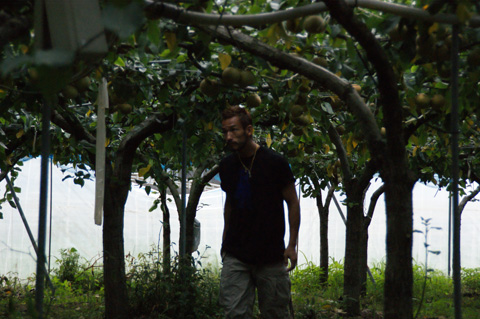
At the orchard, we were able to pick pears from the trees and eat them right there. They were so juicy that the juice dribbled out as we bit into them.
Incidentally, Hide-san kept going deeper and deeper into the orchard to choose the pears he wanted to eat. As I watched, I thought to myself, “He must want to look at them all before choosing the most delicious one,” when Mr. Matsutaka, a pear farmer, smiled and told Hide-san, “The ones at the back are too young to eat.” The next day, we left the inn at 7:00 AM. This travel schedule isn’t physically demanding, but I get at least five or six hours of sleep a day, wake up early, and always eat breakfast at the inn. It’s an incredibly healthy lifestyle, incomparable to my rambling life living alone in Tokyo. Moreover, every day, I meet new people in new places and experience their experiences firsthand. Time passes so quickly, and I feel an incredible sense of fulfillment before bed. I suddenly wondered if this is really what “travel” is. But perhaps that’s a very simplistic way of looking at it. In reality, travel is merely a name for any “experience” a person may have, and perhaps it’s something everyone has already done as long as they’re alive. There’s no definition of what you do, where you go, or who you meet that makes it a journey. As the days passed, I began to realize that Hide’s journey was a journey of learning. As I was seriously pondering what my own journey really was, Maki-kun asked me, “Wow, I had seconds this morning. I’m going to get fat, right? Hahaha.” To which I simply replied, “Yeah, I guess so.” It was a symbolic moment that showed Maki-kun’s exquisite role in this journey. We drove about an hour and a half from the inn to the morning market in Yobuko, in northern Saga Prefecture . However, it was less crowded than I expected, and less lively. When I asked, I learned that due to the recent bad weather, there were particularly few people there that day. “Well, it’s good that I can take my time looking around,” said Hide, unfazed by the bad timing. As always, he was very positive. Afterwards, we visited Nakazato Taroemon, a Karatsu ware maker located about 30 minutes from Yobuko . Here, Hide tried his hand at pottery again. It was already his fourth time, but he had improved so much that it was surprising. He had improved so much that it made me worry that I might accidentally buy one of Hide’s creations if it were casually displayed in a 100-yen shop. Next, we headed to Nagasaki.
Staff Profile:
On-site manager, cameraman, and driver for a trip to all 47 prefectures of Japan.
Having traveled to Brazil alone as a teenager to play soccer,
he speaks Portuguese, English, and French.